
“Excavating Fear” or “If You Want Children to be Safer, Don’t Buy Bulletproof Blankets”

I wasn’t going to post about the recenscreen shot 2014-06-10 at 7.30.47 amt school shootings that we’ve endured as a nation these past few weeks, but here I am.
I wasn’t going to post about them because I just don’t think I can anymore.

When I look down at my son, when I drop him off at school, I don’t think of him as in danger, or as a target.

But I guess we’re starting to these days, right?  I mean we’re talking about more armed guards in schools, we’re talking about lock-down procedures and evacuation routes not just for fire, but also for “live-fire” scenarios.

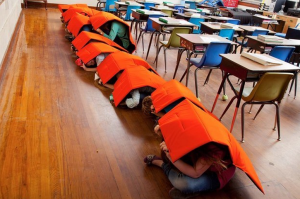
And I guess now we’re talking about bulletproof blankets to cover my baby should someone come shooting up his school.

In Isaiah 11:6-9 we find a vision for a new Earth, and it doesn’t look like like my son huddled under a bulletproof blanket.

And it doesn’t look like my son cowering behind an armed guard with a gun, a teacher with a gun, or even he himself holding a gun.

In that day, “The wolf will lie down with the lamb, the leopard with the goat, the calf and the lion and the yearling together, and a little child shall lead them.”  In verse 8 it gets even better, “the infant will play near the cobra’s den, and a young child will put it’s hand in the viper’s nest.”

The problem with that day is that we don’t think it’s today.  The problem with that day is that we think the prophet is talking about animals.  And, I guess, in a way he is because he’s talking about the created order, the whole created order, being turned on it’s head.

But primarily, though, the prophet is talking about people.  Humans.  You and me.

And the prophet is talking about creation not living in fear, even in natural fear.  It would be natural for the goat to fear the leopard, the child the viper.  But in the world that has “knowledge of God,” even that kind of fear isn’t needed.

Because God is doing a new thing.

See, here’s the problem I have with armed guards, with armed teachers, with armed citizens, and with something as ridiculous as bulletproof blankets: it buys into the fear.

If the day of the Lord is to eradicate fear, then why do we belabor under the wrong assumption that we must continue to purchase it?  This youth at Reynolds High School was obviously hurting and sick.  I do not believe he was a monster.  You don’t have to be a monster to do monstrous things.

But his parents were law-abiding citizens with a closet full of guns.  Why?  Recreation?  Collection? Sport?

It doesn’t really matter now, because in the end they were saved for a mass shooting.

And the remedy to that, I think and believe, is not to buy more guns, is not to buy more kevlar, is not to arm more people.

The remedy for that is, I think and believe, to take the prophet seriously and believe that today is the day when the world is filled with the knowledge of the Lord.  And I don’t take that to mean that everyone is Christian.  I don’t take that to mean that everyone thinks the same things.

The “knowledge of the Lord” is not the ability to recognize God, it is the ability to trust as God trusts.

And how does God trust?  In the Jesus story, God trusts the power of life and resurrection enough not to repay hurt with hurt, but to bathe in love and forgiveness.  I mean, what would it look like if we raised our children not with a closet full of semi-automatic guns and hand guns, even if we teach them to respect guns, but rather with a closet full of the belief that semi-automatic guns aren’t necessary in this world.

They aren’t necessary to have a good time, they aren’t necessary to obliterate targets, they aren’t necessary for common citizens.

They just aren’t necessary.

We need to excavate fear, dig it up like Indiana Jones, and reveal it for what it is: an idol we’re being forced to worship these days.

It’s obvious these people need mental help.  But they also don’t need easy access to weapons.  And I don’t think that’s an either/or situation.  It’s a both/and.

But I really expect the carillon cry on this issue to come from the church, to come from Christians.  I really expect it to come from people who look at Jesus and see someone who didn’t repay evil with evil. I really expect it to come from people who hear stories every damn week about the Jesus who healed the sick, even the mentally sick.  We need to provide that care.  And I really expect it from people who every year hear the story of how Jesus told Peter to put his sword away. “The one who lives by the sword, dies by the sword…”

I really expect it to come from those who would wonder what it means to hold a weapon with no other purpose in the world than for the killing of another human being, a being created out of love by the God who creates all things for joy and good. Licensed police officers, military officers, they all consider that question…at least, I hope they do if they take their work seriously.  We, as a society, have called them to that office, and it’s not one to be taken lightly.

Certainly not one to be taken “recreationally.”  We have licensed law enforcement, and give them licenses, for a reason.  Part of that reason is, I think, because they take it seriously enough to honor the responsibility.  I don’t think the average citizen does, and we’ve shown that by having these “open carry” situations throughout the country now…that, in and of itself, is a sign of mental health issues, I think.

And look, with all this talk, I’m not even talking primarily about gun control.  Gun control has not worked well in Chicago.  I’m all for it, but do I think it will save my baby?  No.  This is a complex issue.  But the church doesn’t just need to condemn the shooting, they need to condemn the situations that led up to the shooting: mental health, easy access to semi-automatic weapons…

And we need to condemn the fact that too many of the “faithful” in this world don’t trust that the Earth can be full of the knowledge of the Lord if they would just live into it.

I’m talking about changing the hearts and minds of this world to realize that the day of the Lord is today.

And tomorrow.

And it was yesterday…we just didn’t trust it enough to live into it.

Why Young Adults Don’t Make Friends Easily Anymore

“I’m lonely.”index

I hear it a lot.  I hear it a lot from young adults.

My armchair analysis is that the “I’m lonely” phenomenon with young adults probably has much to do with our ability to keep our childhood friends over great distances with ease.  Social media and emails have replaced the slow-and-tedious pen pal connections of our parents.

Thus our “friends quota” is largely full post college, and for some, post high school.  We go into adulthood thinking we don’t really need anymore friends (and, thus, not reall cultivating the skills to make anymore).

There are exceptions, of course.  But we have young adults coming to the church, and on the one hand they’re looking for spiritual connection with the Divine, especially the Divine seen through the lens of Jesus.

On the other hand they’re looking for friends.

If my armchair analysis were to go deeper (“let’s explore that, shall we?”) I’d also posit that many of the people who express that they are lonely do so not because they don’t have friends, but because they don’t have the deep, satisfying relationships that provide close, personal connection.

Part of this comes with the changing nature of our society.  I think my grandparent’s generation made friendships largely out of necessity.  The difficulties of war-time life, depression-era life, led to the desire to band together.  My grandparents on my father’s side never moved an they had many friends.  On my mother’s side they moved a few times for my grandfather’s work, but though my grandfather was gregarious, had very few close friends, but kept close ties to a lot of family.  Both sides never seemed too distraught about their friendships (though, granted, I never interrogated them about it either, and I won’t get the chance).

My parent’s generation, I think, made and continue to make friends for fun, and made them pretty easily.  It may differ from individual to individual, of course,  but I see this generation making connections that are pretty tenuous and relatively easy to maintain.  Some relationships are deeper than others, but it doesn’t seem to be the great expectation that depth is necessary for friendship. And those friendships that are deep have continued throughout the years becausemy parents treasured them so much they worked hard at keeping them long before the ease of social media and direct communication.

For my generation though, I’m finding an underlying unmet need for deep relationships, and the desire to make them easily. Those two don’t mix, though.  The kind of depth that forced situations, like the college dormitory or the high school track team, put on you only come through rare, intense situations.  After leaving those pressure cooker environments where strong bonds are formed, my generation is not sure how to make those loose, tenuous relationships of their parent’s generation, nor work hard at keeping really deep relationships from afar (it is work, you know).

Or, when they do make the loose friendships, they find them quaint but not enough.

Likewise, they’re not comfortable making friends for necessity’s sake because, well, they’ve been able to keep their friends from childhood!  Sure they live 800 miles away, but they’re still friends!  They “talk” almost every day over Instagram and Snapchat.

Unsurprisingly, these methods of keeping up do not satisfy a heart that needs something more than just an update.

Sidebar: I believe we can see much of the loneliness and PTSD in our veteran population being due to the fact that the close, personal relationships they formed in the service just aren’t found or easily forged in civilian society. Sidebar over.

Funny enough, I actually see this issue being more of a problem for men than for women.  It might be because I tend to work more with men on these issues, but with the changing landscape of male friendship (men are creating more intense bonds as many social stigmas over what it means to be a man who has male friends are evolving), many men don’t know exactly how to navigate the waters of loneliness.

All of this is to say that I’m finding young adults, myself included, making friends much for the same reason many from my generation get married: self-fulfillment. Hence why we want them all to be deep.

Despite the fact that that sounds very insular and narcissistic (and to a degree that can’t be denied), I think we come by it honestly, having been raised in a culture of “You can be anything you want” and “You can plot your own course.”

The trouble is that we’re becoming disillusioned by the fact that we can’t be anything we want, and that while our life trajectory has a good bit of leeway, surely more leeway than the previous two generations, we still hit walls on either side of the road despite the assurance that it’s all open range.

One of those walls is loneliness, something we thought would be abated by virtual connection.

What the fortune tellers say may eventually be true; “virtual reality” may one day just be “reality.”

But we’re not there yet.  And in the meantime I’m finding more and more people needing real rather than virtual.  I think the church can help if it’ll stop wringing it’s hands over shrinking numbers on the one side, and get off it’s hyper-fundamentalist kick on the other side.

Another sidebar about the hyper-fundamentalist kick in some areas of the church: I once heard a study (which I conveniently can’t find) where it was noted that people make more intense bonds over common dislikes rather than common affinities.  I have a working theory that one of the reasons very conservative churches grow quickly is not because everyone there loves Jesus so much and are aligned on that commonality, but because they dislike being wrong.  And the assurance of conservative churches that they have the right answers is a nice gel. We hate to think we’re wrong. Second sidebar over.

For the other side of the church, the supposedly “shrinking” part, take heart. Actually, shrinking numbers can help with this phenomenon, if attended to correctly and prayerfully.  The real connections that my generation longs for, both spiritually and physically, can be better met by a smaller more nimble group of people; a smaller more nimble church.

And I really (no, really) have hope that the church can teach my generation what it means to make and keep friends in the flesh again.  Of course some will wonder, “Well, we want those looking for Jesus, only, to sustain a religious community, right?  Is someone looking for community and not for faith really who the church wants in it’s doors?”

Of course it is.

The intensity of the Divine-human relationship is best embodied in intensely strong human-human relationships.  The one points to the other, which is why I have so much trouble with the “Jesus and me” language of so much of the evangelical world.

Look, we just don’t make friends easily anymore because we expect a lot out of our friendships these days.  Perhaps we need to let go of a bit of that as a generation.  But perhaps we don’t have to let go of all of it, and perhaps the church can be the incubator to foster such relationships with the honest purpose of helping people be more humanly whole again.

Because whenever I hear the phrase “I’m lonely,” I’m actually hearing “I’m not whole.”

And that is a spiritual problem.