Does it Matter that I Call Myself “Christian” if I Don’t Try to be Involved in a Faith Community?

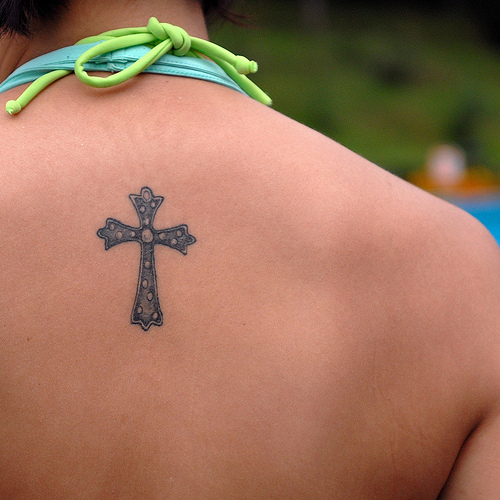
I think about this question a lot.Lower_back_cross_tattoos_for_women_1
Because I hear a lot of people, celebrities and politicians, neighbors and acquaintances and friends, claiming that they are Christian but admitting that they’re not in a faith community and not really interested in being a part of one.

And I’m interested as to what the benefit is for them to claim a faith without practicing one in community.  I want to ask them if it really matters to have that label.

Now, I know people who really long to have a community of faith but can’t find one that resonates with them.  I have friends all across the globe with that reality…and that’s rough.

I don’t think that’s typical, though.  And this question isn’t pointed toward them.  I’m more asking this question with those who claim to be Christian but who don’t make attempts to act on their faith communally in mind.

And this comes with a clear conviction on my part that being Christian means being in a faith community of some sort.  Because you can’t be a Christian alone, I think.

I mean, in some ways I can see the confusion over this issue.  We’ve turned the term “Christian” into a moral identifier in many ways.  It’s a way we privately identify personal beliefs and morals.  And we’ve made it into a cultural identifier as well (and what a travesty that reality is).

The Christian community has given the impression that we can be Christian alone.

It’s like a tattoo we get to wear without needing any real connection.  It may have a back story…but does it mean something now?

But does that mark have a future impact on our lives?  Or is it just a remnant of what was that we still sort of like but don’t know why?

Or it’s kind of like, well, could I consider myself a Republican or Democrat or Green or Libertarian if I never voted?

I don’t want to make too much of a comparison here because it only goes so far, but it’s an interesting one.  Would it matter if I claimed a political party if I never voted?  Could I call myself by a party name if I never practiced?

Well, I guess I could.

But would it mean anything?  Would it do any good?

I want to lean on this a bit…because I think it’s a conversation to have.

In fact, I think churches have it all the time in implicit ways.

And we have it poorly.

We have it every time we baptize a child in a church and then never see that child again (and don’t expect to).  We have it when we mark people with ashes at the bus stop on Ash Wednesday, but don’t expect anything else.

And the result is…what?  A bus full of people who think that faith connection is a bus stop encounter once a year.

I think the result is that we end up reinforcing a cultural Christianity without any real meaning.

So, I want to ask: does it matter?

And I fully get that there are some who are in faith communities and call themselves Christian who don’t trust any of it.  I get that being active in a community of faith does not indicate a Christian faith (however you might define “faith”).  Many people in faith communities are really despicable and don’t act or behave like I think the Christ invites us to.

This is true.  I think this also a symptom of cultural Christianity.

And there are many people are in faith communities, churches, but wouldn’t call themselves Christian.

This is also true.  We have people in my community who struggle with faith, and we encourage that struggle and those questions.  I respect and honor that they’ve decided to struggle in community, that we’ve decided to struggle together, and I think that’s better than struggling alone or not struggling at all.

Or pretending.

And in many ways I’d consider them more authentic than those who call themselves Christian but don’t engage in a community of faith or show interest trying to practice their faith.

Because I don’t think being a Christian is cultural.  And I don’t think it’s an indicator of personal morality.  In fact, I’ve more often than not found the moniker “Christian” to be absolutely unhelpful when it comes to determining morality.

I’m a reluctant Christian because I want to call myself Christian, but often times find that it’s hard to do because we’ve reduced that term down to the lowest denominator as either a cultural indicator or personal morality moniker…and it doesn’t seem to mean much anymore.

And so it’s no wonder that people don’t involve themselves in a faith community.  Because…does it matter?

I think that it does.  The first thing Jesus did was call people around him.  You can’t be a Christian alone.  Even our desert mothers and fathers were part of a larger community in their solitude.

We can’t be Christian alone.  But with the way we use the term “Christian” and the way we have the conversation in churches, I have to ask the question.  Because I’m seriously curious.

What is the benefit?  Does it matter?
Natural Disasters and Prayers and Anger and Ricky Gervais…

A CNN story today made me pause a minute.prayer-hands_2134432b

It notes that many in the Twitterverse were using the hashtag “prayersforOklahoma” to respond to the natural disasters there, and that this rubs some prominent atheists the wrong way.

Ricky Gervais, an outspoken critic of any religion that presents itself in public, tweeted in response, “I feel like an idiot now … I only sent money.”

He’s what Al Franken calls “joking on the square.”  That is, he’s joking.  But not really.

And he’s hilarious.  And that’s a smart retort. And I wish I had thought of it.

It appears he’s slightly miffed at these tweet-prayers, and I have to say that if all people are doing is praying, then Gervais is right.

He’s right to be miffed if that’s the case.

Because prayer must always lead to action, and all your prayers won’t give blood to the injured, security to the now homeless, or tools for rebuilding.

But what Gervais doesn’t take seriously, and perhaps he should, is that prayer for the religious individual is akin to cursing.

Well, I curse as well as pray…some of us do.

But prayer is that response that happens when you have no control over a situation and you must move it from being an internal response to outside of yourself lest it eat you alive.

Or eat a community alive.

Or eat a nation alive.

So while prayer doesn’t give tools, it is a tool that can be used to share burdens, clarify desires, wants, and things we’re thankful for,  and release those things that we have no control over.

And, to be honest, I wonder if Gervais might not need a bit of that release in his life.  Don’t call it prayer; fine.  Call it what you will: meditation, a “time-out,” therapy, external processing.

But prayer is the lifting up of communal and individual need in such a way that real desire is acknowledged, and hopefully, heard.

Now it is true that Gervais doesn’t believe such prayers are heard by God.  But I wonder if Gervais would hear himself better if he prayed.

Look, prayer is not some sort of password that gets God to do what you want.  But prayers of thanksgiving and lament often clarify what it is that we want, and is a way to enact change both in ourselves, and hopefully, the world.  Communally lifting up people, places, situations, things, graces, disasters…it is important and healthy and necessary.

And the religious individual believes this act builds relationship between the human and the Divine.

And the religious individual, I think, can also agree that prayer helps them to know themselves better, too.  It strengthens our relationship with ourselves.

But where we, as a religious community, screw it up is when we respond as this commenter within the CNN article did with this little diddy, “God is still in control!” said Wilbur Dugger, a commenter on CNN’s Facebook page. “Everything (God) does is to get our attention. … My sympathy and prayers go out to those who get caught up in his demonstrations of (God) ruling the world.”

Oh, please.  Do we believe this is helpful?

Hell, I don’t even believe what the man wrote is true, let alone helpful.  And those are not always mutually exclusive in people’s minds.

Natural disasters happen.  Winds whip around. Tragedy strikes.  I don’t think God needs a tornado to get the attention of humanity.  If anything, the Christian should assert that that’s what Jesus was for…

That kind of response comes from a messed up idea about prayer, and God, and…well, makes me a reluctant Christian sometimes.

And in the face of that response, I’d stand with Gervais and shake my head.

And then I’d probably turn to Gervais and say, “You know Gervais, instead of getting ticked at him, why don’t you externalize it a bit? I call it prayer, but you call it whatever you want…”

And then Gervais might know himself a bit better and not get angry at other people’s issues.

And believe it or not, that changes things.

**By the way, if you’re like me and you pray and curse and it moves you to action, 100% of all donations to ELCA Disaster Response go directly to on the ground work through this link.**

On Why A Christian Community Should Agree to Bury the Body of Tamerlan Tsarnaev

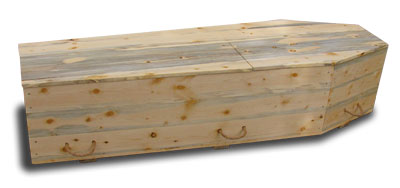
The funeral home can’t place his body anywhere.Coffin

It’s tragic what he did and how it happened.  And he still holds power even after he’s dead.  The power to keep people from offering rest.

See, Tamerlan was sick.  It’s not an excuse by any means.

He was a terrorist.  His brother is a terrorist.

But he’s also human.  And he’s also dead.  And he was sick.

Only sick people do what he did.  And although some would label him an “asshole” as well as sick (which I would agree with), it doesn’t discount the fact that he was sick.

But to let him still hold power like this, to deny a body rest: it’s adding tragedy to tragedy.

We, the Christian community, should bury him.

Thomas Long’s wonderful book Accompany Them With Singing: The Christian Funeral provides some good insight on why Christian burial practices are so important as a witness of the faith.  He writes,

Early Christianity inherited (a Jewish understanding of the body) and intensified it with strong convictions about the incarnation and the bodily resurrection of Jesus.  Doing so stirred Christians not to idealize bodies (as the Greeks did in their perfect sculptures) or to romanticize them (as Sports Illustrated does in its swimsuit issue), but to care for bodies, real bodies, both living and dead, in ways that perplexed and confused their pagan neighbors….What was even odder to Roman eyes was that the Christians “volunteered to take care of bodies, both living and dead bodies…not just of their own families but also of the poor surrounding them…this immediate almost instinctive urge of Christians to care for the sick, the hungry, the old, and the poor aroused comment from their neighbors.” (Long, 29)

To care for the sick, the hungry, the old, and the poor.

In the stories about Jesus, as Jesus was caring for these people, it doesn’t always mention how they got to be the way they were.  Perhaps they were people who had done terrible things in their lives, things that forced them out of circles of care, forced them into solitude.  Perhaps they were people who were just plain sick, and no one could be around them because they were dangerous.

The Christian’s responsibility isn’t to who the body was, it is to the body as it is now.

And why?

Because Jesus had a body, and bodies are important and good, and need to be buried somehow…even if we wouldn’t necessarily categorize the person as being good.

In antiquity Christians would volunteer to bury the bodies of those around them.  Their own savior was once a body without a tomb for a home…a tomb was donated.

Tamerlan Tsarnaev’s crimes were horrible and tragic and beyond the pale.

This is not up for debate.

But his body must be buried, and as a witness to self-giving hospitality, as a witness to our hope in redemption, as a witness to embodiment and incarnation, the Christian church should bury him.

And with him, bury some of the power he somehow is still wielding.

And the fact that we’re reluctant to do so because we’re afraid, or because we hold the flag in front of the cross, or because we think it will be unpopular makes me reluctant to call myself Christian.

Why I Worry When Other Clergy Say, “I Want to Be A Household Name.”

I’m part of an online clergy chat group.images

I don’t contribute to it much, and I don’t always watch it regularly, but it’s usually pretty interesting.  It’s good to have a community, even a virtual one, to share successes and frustrations with.

And yes, it seems that often the same names pop up on the message roll.  And, yes, I wonder if they have work to do and how they have so much time to spend on there.

But today’s posting by the moderator got me thinking.

He began by lamenting how so many in my faith tradition, Lutheranism, are too humble with their work and their writing and their music and their art.  And how we have to start promoting our work and “getting it out there.”  And how we should be “household names.”

And others responded lamenting how we don’t have any Lutheran “Joyce Meyers Ministries” or the like.

And I was lamenting because, although we don’t have any Lutheran Joyce Meyers Ministries, we don’t need any more of those in this world.

Because you have to give up a lot to be a household name.   And I wonder if it’s worth it.

Fr. Richard Rohr isn’t a household name, but I think he’s done so much more for humanity than any televangelist.

Ken Wilbur isn’t a household name, but I think he’s done more for humanity than any “order today and receive a discount DVD set on how to heal your relationships” offer.

Martin Marty is prolific and inspiring, and he’s not really a household name.  Walt Wangerin is beautifully wonderful, and unless you’re Lutheran or really into children’s books, he’s not a household name.

And Ron Strobel, and Kirsten Fryer, and Manda Truchinski, and Josh Ebener….these aren’t household names, but they are ministers who are authentic and doing good work in this world.  And I hope you can check out some of their work.

But I hope they don’t become “famous”…whatever that means.

Because you give up a lot.

I think you give up some ability to live without the trappings of fame and fortune and name recognition and always being forced to do that next best thing.

I think you give up living without the constant burden of profundity.

I think you give up a little of your soul.

Look, I think there are Lutheran clergy out there doing wonderful work.  And I hope people read them, and listen to them, and buy their work, and pray for their work (Jim Honig would be one to check out right away).

I hope they are able to support their families with their work, as I support mine.  I hope they talk about God and Christ in an authentic way and not fall into the trappings of telling people what they want to hear.

Because that’s what you have to do to become a household name.

I hope they don’t become famous.

I hope they don’t get series of book deals that force them to lie about God or their faith, or begin to take themselves too seriously, or come up with “visiting criteria” that places that want them to speak have to abide by (along with enormous speaking fees).

Because we don’t need another Joyce Meyers Ministries, even if its content is different and something I might agree with.

Because authenticity is lost in that.

We need more good people doing the small work.  And if you want to lift that up, go ahead.

Because good people doing the small work won’t, I hope, take themselves too seriously or struggle with profundity.  And they won’t worry that they’re not a household name beyond their own home.

I’m a reluctant Christian sometimes because it’s so easy to fall into the fame trap, and Christians do it so often “in the name of Jesus,” while using obnoxiously large font to plaster their name on the front of all the posters, and fliers, and mailers.

And I wonder if we take Jesus’ call to be yeast seriously if we’re trying to be the whole loaf.