

“Divorce” or “Why the Governor of Alabama Reminds Me I’m a Reluctant Xtian…”

Governor Bentley waving to people who may or may not be "brothers and sisters."

Sometimes rolling your eyes just isn’t enough; sometimes you have to slam down the paper.

That fact alone makes me wish the news cycle of Alabama Governor Robert Bentley‘s inane comments on what constitutes “brothers and sisters” in a Christian context wasn’t on CNN.com.  For one, I can’t slam my computer on the desktop.  It harms my computer.  Secondly, I fear more people read CNN.com than traditional papers nowadays.  Which means there is one more example from the clowncar of the public Christian tumbling out.

But the fact that Governor Bentley doesn’t consider those who haven’t “accepted Jesus Christ as their savior” as a sibling doesn’t irk me half as much as the underlying theological claim.  Namely, that somehow accepting (defined loosely) Jesus Christ (again, loosely defined) as a savior (again…well, you get the picture) has some sort of theological bearing.

Before you stone me, have a seat to analyze that statement.

First, what does it mean to accept something?  Do you assent to it’s veracity?  Is it a mental construction, much like I accept that the number 2 is Real, and yet can’t produce the number 2 purely?

Or is something only accepted when actions flow from its internalization,  much like I accept that the fact that I have a goddaughter requires a response on my part to her faith life?

And if I accept a concept, how can I really tell if I have truly accepted it?  That question alone leads me to my next point: which Jesus Christ?

Is it the “historical Jesus,” the 160lb Jewish guy who walked out of Galilee?  Or is it the “Christ,” the a-sexual salvific presence that God has called us into communion with?  Or is it, perhaps, the Jesus as purported to in various Scriptures who occasionally knows who he is, but more often does not?  Is it the crazy Rabbi of John or the prophecy fulfiller of Matthew?  Which Jesus?

And if we do arrive at which Jesus to accept, we must then contend with how this Jesus is a “savior” and from what this Jesus “saves.”

Sin might be an answer.  But are we talking about the beautiful definition of Sin provided by Luther, this lovely navel-gazing, or are we talking about the sins of John Edwards (the theologian, not the politician…although perhaps the Edwards of the 18th Century might have a thing to say about the contemporary Edwards as well)?  Or are we perhaps talking about communal sin?

And if so, are we discussing Substitutionary Atonement (which, by the way, is a theory to which Christopher Hitchens seems to think all Christians subscribe…yet another error in his “rational process”), or are we talking about a moral example, or…

You see, the point is, I don’t think Governor Bentley would consider us siblings.  Because even if I were to say that I have “accepted Jesus Christ as my savior,” we would probably squabble over what it means to accept something, bicker over who this Jesus guy is (let alone how Jesus is the Christ), and blatantly disagree about what it means to be “saved”…half of my work has been saving people from being “saved.”

I say this not to provide a loophole for relativity, but rather to allow for complexity.

Governor Bentley talks of unification, he longs to have “brothers and sisters,” but only if they conform.  He talks of unification, but paints a picture of divorce.  Those who do not think as he thinks are cut off from him in a very real way.  Where is the sibling nature of a shared humanity?  Where is the sibling nature of a shared state of being?!

Gone.

And divorce of this sort is dangerous.  It’s fundamentalism.

It doesn’t take a radical jump from this type of thinking to a more extreme one.  Bentley’s is one version from the theistic side, so let us look at an atheistic model.  Consider this quote:

“I think the enemies of civilization should be beaten and killed and defeated, and I don’t make any apology for it.  And I think it’s sickly and stupid and suicidal to say that we should love those who hate us and try to kill us and our children and burn our libraries and destroy our society.  I have no patience with this nonsense.”

That is Christopher Hitchens from God is Not Great.  It probably goes without saying that he considers a good bit of the population to be divorced from himself as well, not brothers or sisters, because they assent to something other than his definition of reason or science (both of which are narrowly defined).

Two sides of the same coin.  Both turn my stomach.

Chris Hedges, in his work When Atheism Becomes a Religion, makes a great point concerning this coin.  He writes,

“The blustering televangelists and the atheists who rant about the evils of religion are little more than carnival barkers.  They are in show business, and those in show business know complexity does not sell.  They trade cliches and insults like cartoon characters.  They don masks.  One wears the mask of religion, the other wears the mask of science. They banter back and forth in predictable sound bites.  They promise, like all advertisers, simple and seductive dreams. This debate engages two bizarre subsets who are well suited to the television culture because of the crudeness of their arguments.”

Crudeness indeed. “Accept Jesus Christ as your Savior.”  “Accept Science and Reason as the answer to all of life’s mysteries.”

Both are as simple as can be…and both smack of divorce.

I’ve seen it in my own church as local congregations have splintered off into estrangement over sexual identity discussions.  Obviously “accepting Jesus Christ as your Savior” isn’t quite enough…you must accept the Jesus that dislikes gays.

Sigh.

Brother Bentley, sit down.

Brother Hitchens, sit down.

As Martin Luther so wisely said, “We all have gods, it just depends on which ones.”

And with that, I’ll sit down as well.
Credibile est, quia ineptum est

I’m a terrible shaman.

Despite people’s requests, I have yet to be able to heal a wound without the aid of ointments.  I haven’t been able to call down water from heaven like Elijah (and I question if Elijah literally did as well…that’s not the point of that story anyway).

Nor have I been able to exorcise supposed demons or even provide the “right answer” to life questions such as “Why did he have to die?” Oh, if there were an answer to that question!  Theologians can’t even agree on the significance of Jesus’ death, let alone the tragic death of Congressional staff workers, children, judges, or plumbers at a Safeway in Tucson.

And yet people come to their pastors expecting miracles only to find out that we’re poor miracle workers.  Oh, sure, I don’t deny that miracles happen…just not because of me.  Miracles are un-explainable, by definition.

Priests and pastors have become shaman for the religious in many ways, and its not like organized religion has done much to dispel this notion.  We preside over communion because of “good order,” and yet the magic words and the magic hands are the impression we give off…sometimes willfully.  That’s shameful.

Ordination is done for good order.  But a pastor is not ontologically different.  Any attempt to say they are is, I think, wishful thinking at its most benign and demagoguery at its worst.  The “change” of ordination is simply in title and training; I do not converse with God in a different way than you do.

And what is the change of ordination, really?

Cynically it is the certificate from the church body that declares you as having filled the requirements of an organized religion to teach and lead a branch of the organization.  A letter of call, a funny collar, the blessing from the head of the church.

Speaking from a place of hope, the piece of paper says reliably that an individual is competent in worship and counseling arts and that a community wishes them to lead them.

It says nothing about my ontological status apart from what any certificate says of any individual: “You exist enough to receive this piece of paper for which you have worked.”

And we ordain to retain good order, to have someone to lead, to match gifts and abilities with callings.  We do not ordain to make demi-gods…but I still get:

“Pastor, your prayers worked!” or “Pastor, will you bless us for protection?”

I will pray for you, of course.  I will ask for protection, much as my greatest desire for you is protection, safety, and wholeness.  But I do not have a Divine ATM with a secret code that was placed in my pocket upon ordination.  I do not have Divine influence for good or for ill.

Insight? Yes. Training? Yes. Gifts for communication, for listening, for instruction? Yes.  These I admit that I have, that have been identified as gifts of mine.

But magic hands?  No.

I’m sorry.  I’m no shaman.

I’m just a pastor…for what that means.

And what does that mean?

Well, if we’re sticking with the ancient vocations, I’d say that I’m most like a bard, a traveling storyteller.  I tell the story of God’s work through Jesus, and this seems to change things for people, for situations, for the world.

Does it work like magic? No.  But can I explain how or why it works?  No.  It’s beautifully empty, if you will; empty of definition.  Empty by definition.  And when we try to define it too tightly we end up with magic.

But even though I can’t explain how it works, it does work.

And I travel telling this story, and learning new ones, or pointing out new ones that I see in the people around me.  And then I tell those stories, too.  And it changes things.

But, dear people, it is not magic, it is not shamanism, it is not conjuring up a secret portal of connection with the Divine by which I and I alone (or others who hold similar degrees from human institutions that laughably claim we’ve “Mastered Divinity”) can traverse; a perverted Jacob’s ladder.

And that sort of thinking is indeed what drives people to abandon that search for God altogether, because we so easily let each other down and ourselves down.  Believing in magic gets you far enough to the curtain, until you pull it back and realize that the hands moving the puppets look like your own.

Suffer through another Hitchens reference.  He speaks of traveling through Sri Lanka and coming into a tight scrape between two warring tribes, one of which he was traveling with.  Using his English heritage and shining clothes, Hitchens is able to talk his way out of a tight situation saving him and his companions.  It is at this point that his companions surmise that he is, in fact, Sai Baba in temporary form.  Sai Baba, a psuedo-god of sorts who could perform miracles and raise the dead, had come back to make a visit in the eyes of the Sri Lankans.

Hitchens laughs at the concept.

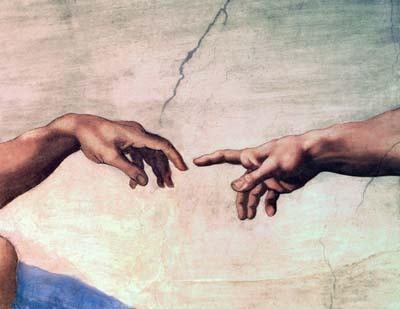
I don’t blame him, though.  He laughs as a person who, upon looking at his hands, sees merely hands.  He cannot see that even those hands can be, from someone else’s perspective or from a teleological perspective, just what is needed in a hopeless situation.

Is this not the definition of salvos?

In telling the story he is attempting to squash the concept of religion.  Unfortunately for him, he propogates it.

Because, you see, he is not the point…and no one should mistake him for it: his hands, his clothes, his English heritage, or his witty speech.

I am not the point, either, even if I’ve mastered divinity…on paper.

It is absurd, yes, to believe that even these hands could be bringing about Divine telos.  But I have to believe it, not in a magical way, but in the way that I know traveling around and telling how Jesus’ hands, and yours, too, is doing the same thing.

Freud made his living off of pointing out transference.  In a way, so do I.  I firmly believe God is transfering Godself onto humanity daily, moment to moment, and I try to keep my ears and eyes attuned to it.

In that I’m a good bard.

But I can’t make it happen…which is why I’m a bad Shaman.

I’m OK with that.

On Doctrine: A Re-Traction

Lennie and George speak in broken conversation.  George telling, and retelling Lennie about the farm that they’ll have one day.  Lennie basking in the glow of this beautiful thought: rabbits of his very own.

But George cautions Lennie when it comes to cats.  Afterall, every farm has to have cats to keep rodents away…and to generally complete the requisite animal quotiant  to relegate a dwelling a “farm.”

“We’d have a setter dog and a couple  stripe cats, but you gotta watch out them cats don’t get the rabbits.”

And Lennie really only desires the rabbits.

“Lennie breathed hard. ‘You jus’ let ’em try to get the rabbits.  I’ll break their God damn necks.  I’ll….I’ll smash ’em with a stick.’ He subsided, grumbling to himself, threatening the future cats which might dare disturb the future rabbits.”

Steinbeck’s Of Mice and Men is a great study in literature…and a great study in people.  Lennie’s defense of that which he desires most, rabbits (or the feel of rabbit fur, or the idea of keeping fur around without breaking the necks of the furry, or whatever you deem his deepest desire is), is typical of people, I think.  In fact, I would say that this reactionary defense is probably the one lone characteristic in Lennie that is not affected by his cognitive struggles.

We defend most heartily that which we desire most.

I received a communication recently from a good friend and fellow pastor asking about the apparent dichotomy created in my first post between doctrine and dogma on the one hand and the Jesus movement on the other.  This friend was quick to point out that he wasn’t disagreeing, but simply wanted some clarification:

Didn’t the Jesus movement necessarily need doctrine (and the creation thereof) in the face of Donatism, Docetism, Arianism, and other such challenges?

The short answer: yes.  Of course.  In any sort of conception of a theological position there is never an “a-position.”  That is, even if you claim to stand nowhere…that is a stance, a place, a position.  The Jesus movement surely needed to refine, re-think, re-discover it’s position on the role of pastors, on the person of Christ, on the oneness and threeness of God…

Yes, of course.

But they are rabbits, are they not?  Dreams of a possibility that can’t yet be touched.

They’re not imaginary; they’re very real.  But they’re only real in so far as they point to the Real.  If they go further, they become no longer the symbols, the subject, of the desired, but the object of desire.

“I desire Trinity.”  “I desire Orthodoxy.”

Instead of, “I desire the God that the doctrine of the trinity helps me to wrap my mind around, if incompletely.”

Instead of, “I desire the God that orthodoxy (however defined) wants to show.”

We need a re-traction of doctrine.  Doctrine should not give something, but should point to something…point outward, further than itself.

Back to Rollins:

“The job of the church is not to provide an answer-for the answer is not a phrase or doctrine-but rather to help encourage the religious question to arise…the silence that is part of all God-talk is not the silence of banality, indifference or ignorance but one that stands in awe of God.  This does not necessitate an absolute ‘silencing,’ whereby we give up speaking of God, but rather involves a recognition that our language concerning the divine remains silent in its speech.”

We say too much in saying anything, and say too little in saying nothing.

But doctrine, for all its benefit, has become a rabbit.

“Believe this and be saved.  Attack this and I’ll smash you with a stick.”

This past weekend I watched religious TV on Sunday morning…the bed and breakfast had cable.  I flipped through four different religious programs.  Some were complete services, some were snippets of “teachings,” some were call-in shows.  Very different.

Yet very similar.

They each promised to give the viewer something.  One was “The Four Essentials of Faith.”  Another was, “How God can Help your Wealth.”  Fill in the blank here with some other infraction on the Second Commandment, as I am most certain that God does not want to help you, or me, get wealthy in any sort of way that we would identify as wealth…

And they each reminded me of why I’m a reluctant Christian.

These programs are so popular with their lovely memes impregnating the minds of views, both live audience and electronic audience.  And this is the mistaken, idolatrous promise (illusory as it is) of doctrine: it gives you something.

Instead, the real promise of doctrine is that it points to something…points past itself.

Please, Lord, save me from being saved and all the wonky ways we’ve devised to save ourselves from each other, from other doctrines, from, whatever it is we run from.

“The religious individual tears out all the idolatrous ideas that have impregnated the womb of his or her being, becoming like Mary, so that the Christ-event can be conceived within him or her-an event whose transformative power is matched only by its impenetrable mystery.”

Do we need doctrine?  In so far as it points us toward that which is beyond our knowing, yes.

Do we need to be saved from doctrine?  In so far as it has become our rabbits, mice, soft toys to pen, and hold, and pet, and defend with sticks, yes.