
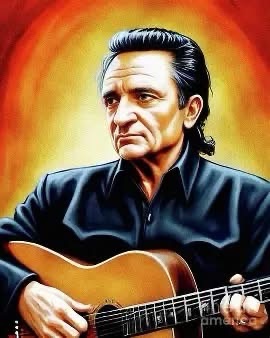
Today I would lobby hard that the church remember a modern muse whose lyrics live on: Saint Johnny of the Cash, Minstrel Man in Black.
Saint Johnny was born in 1932 in Kingsland, Arkansas, living his childhood on New Deal land offered by the Roosevelt Administration during the Depression where tenets could pay off the land through working it. There he picked cotton with his family, singing while they worked. Even there the family was not immune from the Depression, with flood and insect causing typical farming issues that seeded some of his future songs.
He was extremely close to his brother, Jack, who died in 1944. Johnny felt continual guilt for Jack’s death, feeling he should have prevented him from going to work at the factory that day, the place of the tragic accident. These dots of hardship and tragedy became fuel for Johnny’s work.
In 1950 Saint Cash enlisted and served in the Korean War as a morse code operator. After being discharged, he and his new wife Vivian made their way to Memphis where Johnny would sell appliances by day and jam by night. He rubbed shoulders with many of the wandering bards of the day, including a hip-swinging Presley who struck up an impromptu jam session with Cash at the studio one night. Having been raised on Gospel, Cash understood Elvis’s style and they meshed well.
It’s just one of many duets Cash would do in his fateful life.
After playing back up for many, Cash began making his own albums, finding good success with “I Walk the Line,” eventually signing with larger and larger labels. He had the distinction of wearing all black while performing, apparently because it was easy to keep clean, which garnered him the nick name “The Undertaker” by other performers, and eventually “The Man in Black” by his fans.
As Saint Johnny got deeper into the music, he also got deeper into the “scene,” admittedly becoming addicted to various vices. He would wrestle with these addictions his entire life, with periods of being clean and relapse, making him a very human saint, in my estimation. These addictions would both hinder his personal life and bolster his performance life, with “Ring of Fire” being the crossover hit it is due to a frenetic mindset fueled by addiction.
Tragically, though, addiction would be what he would cite as the reason his first marriage dissolved. “I was taking pills, and then they started taking me,” he would be known to say.
He worked hard to get clean, and proposed to June Carter in 1968, who agreed to marry him if he got clean.
Saint Johnny was known for reaching out to those the world marginalized. He was a tireless advocate for First Nations populations, highlighting the way that they’ve been hurt and abused by the government. He also was known to perform at local prisons, finding the imprisoned population at risk of being hurt or forgotten in a system that keeps boots on necks.
He lived a life of touring and tv shows, recording and reacting to the calls of the time. His deep convictions and deep contrition at a hard-lived life provided for a pattern of confession and forgiveness that told of a deep faith and internal mysticism, some of it playing out in his music.
Even toward the end of his life he continued to record, producing music as he slowly struggled with Shy-Drager Syndrome and began to lose functionality of his limbs.
He died on this day in 2003, preceded in death by his beloved June only a few months prior.
Saint Johnny of the Cash is a reminder for me, and should be for the whole church, that a life of forgiveness (and seeking forgiveness) is ever possible, and sometimes that should come out in song.
-historical bits from public sources
-icon written by Sarah Kirk

