
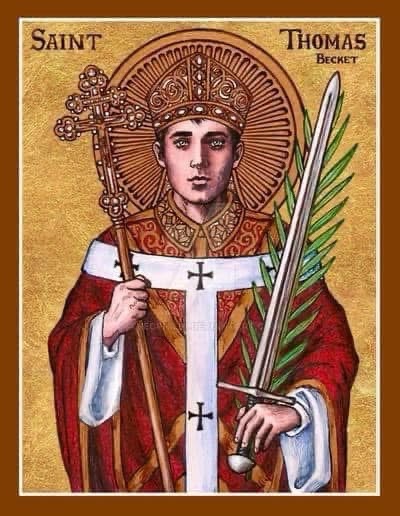
Today also marks the saint day of Saint Thomas Becket, Archbishop of Canterbury and Gadfly of King Henry II.
Becket was ordained a Deacon and then Archdeacon for the Archbishop of Canterbury in short order after studying in Paris as a young man. He was born the son of the sheriff of London in 1118, and therefore had many rights and privileges offered to him, including an inroad with King Henry II which allowed him to live the high life.
King Henry II decided, apparently on a whim, that Becket should be named Archbishop though he wasn’t even a priest. Becket protested, saying, “Then I would fall from your favor, your Majesty.”
Henry disregarded this prescient warning, and ordained him a priest and then elevated him to Archbishop in 1162 all in one fell swoop.
Becket, now as Archbishop, took his position quite seriously. He abandoned the trappings of the comfortable life he had been leading, and assumed the role of “shepherd of souls.” He and King Henry soon were on the outs as Becket argued fiercely over the boundary between the church and the state. The feud became so fraught that Becket was forced to leave Britain and take up residency in France, where he lived as Archbishop of Canterbury in exile.
Six years after being exiled, Becket was allowed to return, but the feud continued. One night King Henry, in a rage, asked rhetorically, “Who will rid me of this priest?!” Four knights in the room, who didn’t understand a rhetorical question when they heard one, rushed off to the cathedral in Canterbury and murdered Becket in front of the altar.
Becket’s last words were, “For the name of Jesus and in defense of the Church, I am willing to die.”
The people of England were shocked and dismayed, and soon after his death miracles were reported at the tomb. In 1173 the pope canonized him, and Henry was forced to be whipped by monks from the abbey over the tomb as penance.
The Henrys’ would have the last laugh, however, as King Henry VIII would avenge his ancestor and destroy the shrine over the tomb.
You may know Becket’s story as this ambitious and tough-minded monastic has inspired numerous works of art including Tennyson’s “Becket” and Eliot’s “Murder in the Cathedral.”
St. Thomas Becket is a reminder for me, and should be for the whole church, that the church cannot be in service to the state if it is to adequately critique it. Becket knew this…I wonder if we sometimes forget it in nationalistic fervor.
-historical bits from Pfatteicher’s New Book of Festivals & Commemorations
-icon written by Theophilia
 Reluctant Xtian