
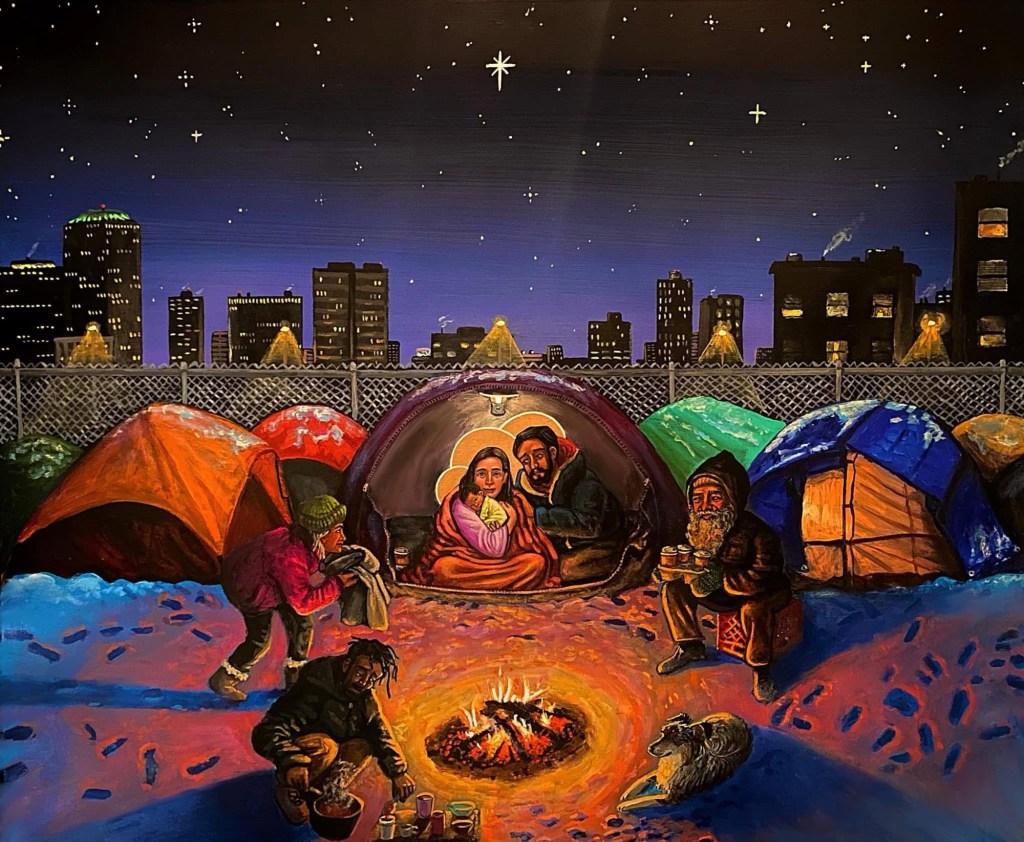
Today the church honors the Festival of the Incarnation, also known as Christmas.
While not originally one of the major feasts of the early church, Christmas has become both a major sacred observance (usually following the ancient rite of observing a feast day starting on the evening before the actual day), as well as a secular cultural observance of immense proportions in many places throughout the world. Christmas is now the feeding trough of nostalgia and celebration and kitsch while also remaining an important holy day for those who keep the feast!
Many Christians may be surprised to learn that Christmas was not a high holy day for the first church, but it makes sense when we remember that the first church was more focused on the acts of the Christ rather than the birthday of the baby (and because that birth story is only told in two Gospel accounts, and even those don’t agree with one another on the major details). The early church was more interested in the Resurrection and the Festival of the Pentecost (the latter being uniquely Christian in flavor), but because ancient winter festivals were so prominent in the local zeitgeist of so many cultures, the church adapted these local practices and melded them into a celebration of the birth of the Christ and, boom: Christmas was born.
Melding the nativity of Jesus with other observances (Saint Nicholas, Saint Lucy, Saturnalia, and Yule games), eventually an Odin-like character (Santa) would deliver presents (like Nicholas) in many places, taking on an elvish persona that reflected northern Scandinavian lore more than any Palestinian birth story.
When confronted with these melding of customs and lore an observer is given a few options: adopt them, adapt them, or rebel against them.
The church has done each of these, for better or worse, at different points in history. But let’s not pretend that today originated as anything Christian. If anything, this feast above all others is an example of Christianity being nimble (which is ironic because it has only become more inflexible as the years progressed and it’s secular power has been threatened).
Still, the Festival of the Incarnation is a beautiful feast with many local traditions focusing on that first family of the faith by gathering their own families from far and wide. And if your family couldn’t gather together you’d wait eagerly for that “Christmas letter” from kin across the ocean, the precursor to those staged Christmas cards that stress so many out.
At its best today is a reminder that the Divine still breaks into this world in unusual and hidden ways. After all, God coming in such a lowly manner to an ordinary woman of no note is odd, and the fact that the first to witness it are shepherds (who couldn’t even testify in ancient courts because they were considered so unreliable!) makes the whole thing even odder! This inconceivable conception is worth a gift-giving tradition, yes? May we all receive the odd gift of the Divine presence in our lives.
At its worst it’s overly romanticized and divorced from the powerful story it is.
A world in turmoil is visited by God not through a conquering war cry from a general on a horse, but through the cry of a baby born in the food trough of a horse. And the fact that the ancient lands where this story was said to take place is once again in upheaval is even more of a reminder to dismiss the romanticism and embrace the radical subversive nature of the whole thing.
The Festival of the Incarnation is a reminder for me, and should be for the whole church, that God is still showing up in odd and powerful ways…if only we’d remove our romantic blinders long enough to see it!
-icon written by Kelly Latimore Icons highlighting how the Holy Family would be in a tent city, or worse, under rubble were this story to be made real today. A recent icon, commissioned in the last few weeks, does indeed show the Holy Family born in the rubble of Gaza, but I chose this one because for those of us Stateside this scene hits home.
Indeed…it is real today for too many. Far too many…
 Reluctant Xtian