
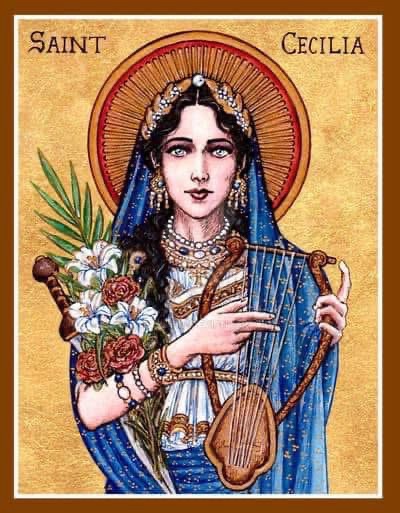
In a little break from the traditional calendar, though still well within the bounds of convention, I’d propose that we honor a saint on this day that is normally honored tomorrow (but because of tomorrow’s more modern saint, this one deserves a slight adjustment I think): Saint Cecilia, Martyr and Patron Saint of Musicians.
Born sometime in the early third century, even before Christianity had really started to come into its own, the history and lore around Saint Cecilia is very suspect save for the fact that we do think there was a Cecilia in the very early church, and we do think that she died.
Everything else is really unknown, except that we are certainly sure that she broke Paul Simon’s heart at some point and definitely shook his confidence, daily.
I digress…
Some lore claims that Saint Cecilia was born into nobility and died in one of the early purges of Christians in Rome around the year 230 AD under Emperor Severus. Other sources claim that she may have lived much earlier and died under the purge in the late second century by Marcus Aurelius.
Regardless, it is considered history that this dear saint did at one time live in the early church, and did at one time die along with her husband and a host of other early martyrs.
It is said that Saint Cecilia took a vow of virginity in her youth and, despite her arranged marriage, kept that vow the enirity of her short life. To convince her husband that she was to keep her vow, she told him that an angel was watching over her. He asked to see this angel, and she said that his eyes would be open if he received the sacrament of baptism.
He agreed to be baptized, and indeed claimed to see this protecting angel that Saint Cecilia claimed was there. He respected her vow their entire marriage.
Saint Cecilia’s martyrdom became the stuff of lore not only because, well, martyrdom is notable in and of itself, but because it was said that she lived three days post-execution, evoking images of the Christ himself. She was buried by the Pope in the Catacomb of Callixtus, and in 1599 it was said that her body was found and that she had experienced no passage of time at all…a supposed miracle.
All of this is, of course, story. But stories shape us. It’s why “story” is the most important part of the word “history.”
Oh, and I know you’re wondering why Saint Cecilia is the patron saint of music, right? Never in any of the lore does it have any suggestion that she had a musical bone in her body, but in one account of her life (an apocryphal account of course) it is noted that on her wedding day, despite having taken a vow of virginity and despite being forced to marry and despite the difficulty of that day, she “sang to the Lord in her heart.”
Because of this Saint Cecilia is said to be the embodiment of the musical cadence of the liturgy, reminding the faithful that despite what is going on in their lives (or even because of it?!) a song still festers inside of all of us, encouraging us to sing a Divine note.
Because Saint Cecilia’s story is so muddled and riddled with so much lore, I think that while she still deserves a feast day, moving it a day up does no harm (and makes space for tomorrow’s saint). This is especially true because while some stories claim she died on November 22nd, others are unclear on the date…so there seems to be some flexibility here.
Regardless, Saint Cecilia is a reminder for me, and should be for the whole church (and world?), that each of us has a song to sing, by God. No matter how we find ourselves.
So, Beloved, sing.
-historical bits gleaned from public sources
-icon written by Theophilia
 Reluctant Xtian