
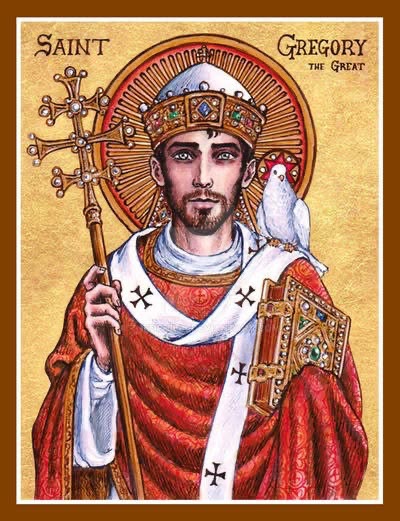
On March 12th the church honors and reveres one of the most dedicated early leaders of the church: Saint Gregory the Great, Bishop of Rome and Reformer of Liturgies.
Saint Gregory the Great (you can call him Greg) was born into an important family in the middle of the 6th Century who had long been converts, his grandfather having been Pope when he was young and full of dreams. Saint Gregory was born into great wealth, had the benefit of a world-class (for the time) education, and became a Prefect of Rome (basically an Alderman), was in the Roman Senate, and proved that ambition and the roll of the privilege dice were all that were needed to be in the seat of power.
And then his father died.
In the shadow of this death, something happened to Saint Greg and he decided to not only become a monk, but turn his family home into a monasttery and give most of his inheritance to the poor.
Saint Gregory was ordained and was sent to Constantinople, learned about the church in the East, and then returned to Rome to become the personal counselor of Pope Pelagius II. While in Rome a plague devestated the city killing masses, including Pope Pelagius.
Once again Saint Greg would be called to take the seat of power, becoming Bishop of Rome in short order, but not being consecrated for a bit because the church of the East had to first give its blessing. While he waited to assume the miter Saint Greg kept himself busy by personally tending to the sick and dying in Rome, leading the people there in prayer for release and relief.
As if the plague wasn’t enough, in 592AD the Lombards besieged Rome. Because so many of the civil leaders had died of the rampant sickness, Saint Greg was the one to rally the people to defend the city and contribute to the rebuilding through a yearly tax.
Saint Greg basically became a real-day superhero for many in Rome. Civil government had failed. Appeals for help from others (looking at you Byzantine Empire) had failed.
Saint Gregory had empowered them to succeed and get through it.
And not only that, Saint Gregory the Great had done it with care and compassion for the poor and calls for justice for the needy. He instituted liturgical reforms, even presiding at a variety of parishes himself, writing chants and prayers (you know them as “Gregorian”), calling for the Alleluia to be sung except during Lent (you have him to blame), changing the second petition of the Kyrie to “Christ have mercy…,” reminding priests that their sermons needed to be timely and good, and to cap it off he stuck the Lord’s Prayer to the spot in the Mass where it currently remains during the Eucharistic rite.
He was busy. He claimed that he saw himself as the “servant of the servants of God.” Not a bad way of looking at the office, no?
But for those of us who come from the Isles, we know of Saint Gregory mostly because it was the missionaries he sent who decided to talk about Jesus in the frigid north of Briton.
Saint Greg was not particularly brilliant (relatable content), nor was he supremely profound (ditto), but he was known as sincere and masterful at understanding how power can both trample the people or elevate them, and he chose to elevate them.
Though he described himself as “sickly” his entire life, and said he longed to live as a simple monk somewhere in the countryside, he lived a very robust and public life until his death on this day in the year 604AD. Though our Roman siblings honor him in September (so as to avoid his feast during a potentially penitential season), Lutherans prefer to honor him today.
Saint Greg the Great is a reminder for me, and should be for the whole church, that you don’t have to be brilliant or profound to be kind and make a whole lotta damn difference in this world.
Let those with ears to hear, hear.
-historical bits from Pfatteicher’s New Book of Festivals & Commemorations
-icon written by Theophilia at DeviantArt (where you can purchase it)
 Reluctant Xtian