
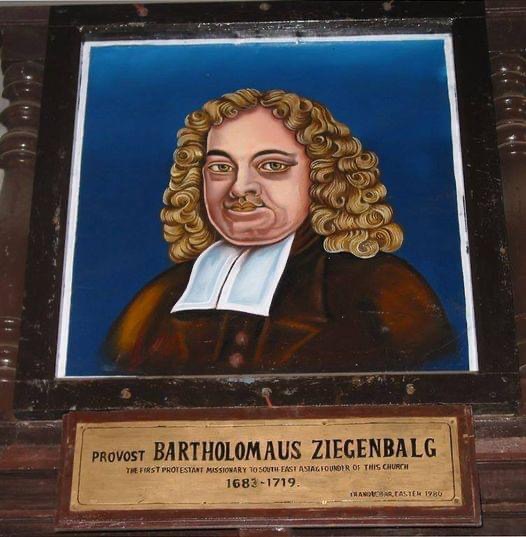
Today the church remembers a little 17th Century known missionary who deserves more nods than he gets: Saint Bartholomaus Ziegenbalg, Missionary to India and Defender of the People.
Born in Puslnitz, a small town in Saxony at the tail end of the 17th Century, Saint Bartholomaus (Bart) was born into poverty but gifted with a wonderful intellect, a combination that time after time has proven to be powerful when the world gives it a chance, no? He studied hard, was raised in a pietistic Lutheran home, and upon graduation “said yes to the (ad)dress” that the King of Denmark gave, imploring folks to go and preach in southeast India.
So, in 1706 St. Bart and his associate, Heinrich Plutschau set out for Tranquebar, India with hopes and dreams.
They were met with much hostility when they arrived, both by the ruling Dutch who didn’t look kindly on visitors, and by local Hindu religious leaders who didn’t love these zealous missionaries stirring things up amongst the masses. But St. Bart wasn’t just interested in converting folks (despite what the Danish church wanted him to do). He set up a printing press and became enamored with the locals, their customs, their religious culture, and their language. He wrote and published volumes on Tamil, sending his writings and thoughts back to Halle where they were shoved away without publication. He translated the whole New Testament into Tamil, a translation that has had a few revisions over the years, but that is largely the authoritative one still in use. In fact, the church dedicated to St. Bart, the Church of the New Jerusalem, organized in 1718, is still an active parish today!
But St. Bart did not have it easy, both from the outside and on the inside. The Danish Church didn’t like that he advocated for the physical and mental health of those he served, and wished he would just “save them”…an ongoing issue in the church writ large today, I’m afraid. In addition, he was often sick himself with undiagnosed ailments both physical and psychological.
As the year 1708 came to a close you would find St. Bart in a local prison, charged with inciting rebellion amonst the people.
That would not be the end of his story, however.
St. Bart forged on, continued to make partnerships with the local people and other mission work in the area. He married in 1716, finally published that New Testament he’d been translating for so long, and founded a local seminary to train clergy from India so that the church wouldn’t just be a replica of Eurpean institutions, but be contextual to the people. He also began translating the Hebrew Scriptures into Tamil, and got as far as the book of Ruth before he fell ill for one final time.
He died on February 23, 1719 at the young age of 36, and his commemoration was moved to today to make space in the calendar to honor his life.
St. Bart had a direct influence on the flourishing of the Tamil-speaking Lutheran Churches in India today.
St. Ziegenbalg is a reminder for me, and should be for the whole church, that caring for the entire person is necessary. Indeed, Jesus cared about bodies (why else would he be resurrected in one?!), so the church needs to care about bodies, too, not just “souls.”
Let those with ears to hear, hear.
-historical bits from Pfatteicher’s New Book of Festivals & Commemorations
-plaque from Tamil Evangelical Lutheran Church in Tranquebar, India
 Reluctant Xtian