
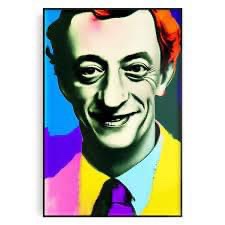
Today I would encourage the church to formally remember one who moved the needle on equal rights in America: Saint Harvey Milk of San Francisco, Politician, Activist, and Martyr.
Saint Harvey was born in 1930 in the outer-ring suburbs of New York City into a Lithuanian Jewish home. A bit awkward and goofy as a child, he loved being the class clown, played football in high school, and fell in love with the opera. He went on to major in mathematics as an undergrad, and eventually served in the Navy in the Korean War. His departure from the military would not be a kind one, though, as he was forced to accept an “other than honoerable discharge” due to the fact that his superiors found out that he was a gay man.
Saint Harvey drifted a bit after returning to New York from the war. He took positions where his mathematical acumen was helpful (a teacher, an actuarial analyst, a researcher), and through the help of the 60’s counterculture found his way to the Castro district of San Francisco where he opened up a camera shop on Castro Street. In this evolutionary period Saint Harvey’s very conservative political and social views also started to shift, which would spur on his activism in future years.
What might be largely forgotten to many is that in the 60’s and 70’s homosexual acts were often-times a felony, and anyone charged with these acts would have to register as a sex offender. In San Francisco the political elites were trying their level best to pander to a conservative voter base, and encouraged law enforcement to target these offenses above all else. These targeted hate tactics, along with skyrocketing taxes and an inefficient political environment, encouraged Saint Harvey to enter into the political arena with showmanship and blunt talk.
The gay political machine in San Francisco wasn’t particularly fond of Harvey Milk. They thought that he didn’t play well with them and wanted to blaze his own trail…which, honestly, was a fair assessment.
Having found his true calling in life, Saint Harvey would go on to run for different positions in San Francisco politics, starting with city supervisor. Though he gained many allies, especially from organized labor and business owners in the Castro, his showmanship was not enough to get him elected at his first go-round. In 1975 he decided to run again, and in a sea-change election the mayor, sherriff, and district attorney all shifted to the left, and Milk was offered a seat on the Board of Appeals for his role in changing the dynamics in San Francisco politics.
In 1976 Saint Harvey decided to run for the California State Assembly. Often bombastic and occasionally manic, Saint Harvey positioned himself as the underdog in the race, and though he was close to getting elected he found out that mere outrage and rhetoric wasn’t enough to cross the finish-line a victor. Having gay candidates who were out and running as their true selves, though, was stirring not just San Fancisco, but also a nation who was watching. Candidates standing for gay rights started running in races across the states.
This movement of gay rights candidates no longer hiding in the shadows of the closet caused a backlash, though. Christian conservatives started a counter-movement led by popular singer Anita Bryant with the horrible and unmistakably prejudice title “Save Our Children,” insinuating that somehow children are harmed by the mere presence of openly gay persons in their midsts.
These sentiments, unfortunately, persist today.
This Christian conservative movement led the repeal of many newly passed equal rights amendments. Gay rights protests popped up around the country in response, but the laws continued to be overturned and violence against the gay community skyrocketed, especially in San Francisco. Trying to capitalize on the anti-gay movement, California State Senator John Briggs introduced a bill that would ban out gay and lesbian teachers from teaching in California public schools. He hoped he’d be able to run for governor on his anti-gay ideas, and even called San Francisco a “sexual garbage heap” because of homosexuality.
At this time San Francisco reorganized how it elected its supervisor elections, allowing neighborhoods to directly elect their supervising representatives. Harvey Milk, already well-known and having learned from his political mistakes of the past, was a leading candidate to represent the Castro. He wasn’t only interested in gay rights, though. Milk saw the need for less expensive childcare, promoted free transportation in the city, and wanted the police to have an oversight board.
Saint Harvey became the first openly gay non-incumbant to win an election for public office in the United States.
Still kind of a thorn in the side of the political establishment, and not one for being a wallflower, Milk took on big business and the political elites, irritating most everyone. Despite his election, though, anti-gay sentiment continued to fester in the halls of power, and Proposition 6, a proposed law that would make firing gay and lesbian teachers (and any supporters of gay rights) mandatory was gaining steam. In response to Proposition 6, Harvey Milk went on a speaking tour, debating John Briggs at every turn. Briggs claimed that homosexual teachers were trying to “recruit” children, whereas Milk responded that if children were copying their teachers there’d be a hellava lot more nuns running around.
Ronald Reagan came out against Proposition 6. Jerry Brown came out against it. President Carter came out against it. It failed by more than a million votes.
On this day in 1978 a replacement for the newly resigned supervisor, Dan White, was to be announced. White had been at odds with Milk on a number of issues, and made the point of voting against any of Harvey’s initiatives on the Board of Supervisors. White had resigned claiming the salary was inadequate, but then sought to be reinstated. Mayor Moscone eventually refused to reinstate Dan White, seeking more ethnic diversity on the Board of Supervisors, better reflecting White’s district.
White snuck in City Hall with a police-issued relvolver, shot the mayor multiple times, reloaded, found Supervisor Milk, and shot him over five times.
He was 48.
Dan White’s trial gained national attention. The jury who would serve was not representative of the city population, and anti-gay sentiment continued to fester as many decided that White had done a good political deed in this double murder.
White was acquitted (!) of first degree murder, convicted of voluntary manslaughter, and with good behavior would be released within five years despite confessing to the shootings. His defense? He was confused by the machinations of the political elites of the day and had gone on a junk food binge the night before, causing a lack of mental clarity.
Riots and marches ensued, and the political landscape remained fraught for some time.
One might balk at the idea of a gay Jewish man being remembered as a saint of the church, and I understand that sentiment. However there are times when leaders have emerged who, like the Christ, have shown themselves to be on the right side of human dignity in the face of so-called Christian opposition, and Harvey Milk is one such example.
Harvey Milk was more Christ-like than the Christians when it came to human dignity, and his legacy should cause all of us to think honestly about where we are today when it comes to the growing list of anti-gay legislation being proposed and passed across this country.
Saint Harvey Milk is a reminder for me, and should be for the whole church, that sometimes non-Christians are more Christian than the Christians…which should make us honestly think and reform, by God.
-historical bits from publicly accessed resources
-icon written by the saints at Joy of Missing Out (note that Trinity Strores Icons has a wonderful Milk icon, but it’s watermarked and out of respect for their work I didn’t use it. However, I would encourage you to purchase Br. Robert Lentz’s icon if you’re looking for a way to honor Saint Harvey of San Francisco)
 Reluctant Xtian
Sometimes, the title of this post is correct.