
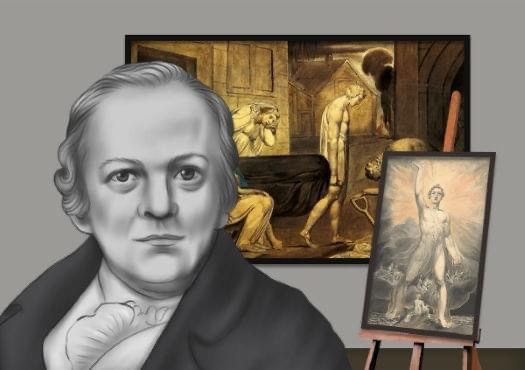
Today I would lobby that the church remember a visionary who, though largely dismissed while he was alive, is widely regarded as a brilliant artist whose body of work continues to influence humanity today: Saint William Blake, Poet, Painter, and Bucker of Organized Religion.
Blake was born in the middle of the 18th Century in London. He attended school just long enough to learn how to read and put pen to paper, and was then homeschooled by his mother with the Bible being used as a primary text. Because he was seen as a stubborn child, his parents decided to send him to a special school at the age of ten to do what he loved: drawing classes. There he practiced his art while reading whatever his heart desired, and it was at this early age that he started to pen his first poems.
Blake’s family were known as English dissenters, having rejected the state church of England, though they still considered themselves Protestant. Though he didn’t participate in any formal religion, his work put him in close proximity to communities of faith, and he claimed to have experienced mystical visions and dreams, even from an early age.
You could say he was “spiritual but not religious.”
As a young man he apprenticed as a printmaker, and then enrolled at the Royal Academy, studying art and becoming a vocal (if not radical) critic of most everything he deemed as conventional. As you can imagine, the contrarian streak did not exactly make him popular, though he did make a few notable and similarly radical friends at the Academy (like George Cumberland).
Blake had difficulty in all sorts of relationships, it would seem. His first proposal was a flop and, upon explaining that flop to a young woman, Catherine Boucher, he inquired if, after hearing his sob story she might be interested in marrying him.
She agreed.
Catherine was largely illiterate at the time of their marriage, but Blake would go on to teach her how to read, write, and engrave, making her perhaps his most valuable aid throughout his artistic career.
Blake would go on to form a printshop which would also double as a gathering place for a variety of intellectual dissidents, from radical theologians to early feminists to supporters of the French and American revolutions. His engravings, etchings, and even his own pen would espouse these radical notions in vibrant ways, as his art put in practice his politics and theological penchants.
In short: he wasn’t an artist “for hire.” His work reflected his thoughts.
Blake would live his whole adult life married to Catherine, though his own thoughts on marriage, chastity, and sexuality were varied and unconventional. He saw much of state-sanctioned marriage as particularly harmful to women (inhibiting their freedom), and his thoughts and those of many in his corner may have been a glimpse of the 19th and 20th Century “free love” movements.
Blake would work for a variety of poets illustrating their words, publish and present a wide variety of critiques of artists and intellectual thought, and in his last year of life began on the ambitious journey to illustrate Dante’s Divine Comedy, dying while still working on it on this day in 1827. Of all of his artistic pieces, those depicting glimpses of the stories of scripture and those from Divine Comedy are probably most well-known, and most striking.
William Blake’s legacy is varied and lasting. His radical politics inspired John Tavener, Bob Dylan and Jim Morrison. His radical stories moved modern day authors like Philip Pullman. His radical images sparked the imagination of Hollywood directors (“The Red Dragon”) as well as holy people across generations. His detailed and, at the time of his life, wild analysis of human nature is a precursor to Jung and Freud.
Blake lives on.
Perhaps my favorite quote from him is this little ditty:
“To see the world in a grain of sand,
and to see heaven in a wildflower,
Hold infinity in the palm of your hand,
and eternity in an hour.”-from “Auguries of Innocence”
Because he was so radical, so odd, he was deemed “mad” by many in his day. But he is a reminder for me, and should be for the whole church, that, well…
Blessed are the odd, for from their imagination we glimpse the infinite capacity of God.
-information gleaned from publicly accessible resources
-opinions mine
 Reluctant Xtian