
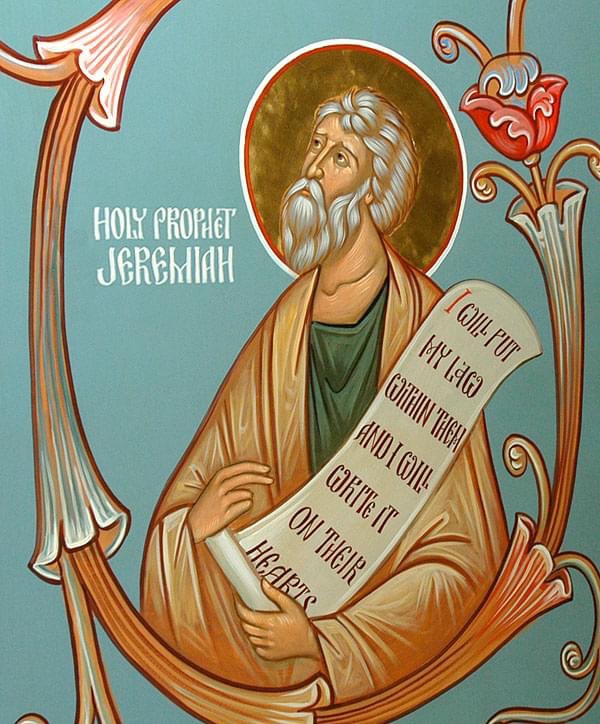
Today the church remembers a warning beacon of a prophet who sounded the alarm (but few heard it): Saint Jeremiah, the Weeping Prophet.
Saint Jeremiah lived between 650 and 570 BCE, telling truths during the 13th year of King Josiah of Judah. He was mentored in the prophetic tradition by Zephaniah and called into it by Divine voice in 626 BCE.
And what was the call?
To announce that Judah should reform and turn from their ways, or else destruction would surely come. Saint Jeremiah resisted the call, reminding the Divine that he was “only a child,” and not a great public speaker (a protest used by many prophets, I might add). These protests are pretty curious, of course, because it’s pretty clear from the beginning that Saint Jeremiah was an articulate speaker, and perhaps had been schooled in oratory in one of the early Jewish schools. In the Book of Jeremiah, of which he authored (along with 1 Kings, 2 Kings, and parts of Lamentations with the help of his trusty scribe, Baruch) Saint Jeremiah is said to have been fed words by God…an odd meal, I’m sure!
Ultimately the reforms that King Josiah (to his credit!) put in place seemed to not be enough to avoid disaster. Speaking the harsh truths that he did prompted many people to shun him, his family to plot to take his life, and ultimately he became a priest on the run. It’s important to note that Saint Jeremiah was part of the elite of the day, the inner circle, critiquing the power structures that kept the wealthy, wealthy, the powerful, powerful, and the hard-strapped, hard-strapped. With Saint Jeremiah preaching from the inside, and Saint Amos (the yin to his yang) preaching from the margins (as a simple farmer) years before, you’d think folks would have heard a little better, right?
But power is seductive. Money has a way of silencing dissent. Marx wrote that “Religion is the opiate of the masses,” but sometimes I wonder if health insurance and benefits are the true opiates…
Saint Jeremiah said that he tried to stop telling truths, but that the words burned his throat and tongue if it sat too long. Perhaps too many of us dull the burn with platitudes and “just waiting out the clock.” He called out the religious elites. He called out the political elites. He called out the ruling class.
And they threw him into a cistern, attempting to starve him. He was saved by Ebed-Medech, an Ethiopian, and eventually released from captivity by the Babylonian army.
Turns out, when Babylon laid siege to Judah, the Babylonians were the ones who understood mercy.
Saint Jeremiah is a reminder for me, and should be for the whole church, that sometimes critique must come from those sitting at the table.
-historical bits from publicly available information
-icon written in traditional Orthodox style
 Reluctant Xtian